Monday, May 28, 2018

Bancorp Bank (TBBK) & First Midwest Bancorp (FMBI) Financial Contrast

Bancorp Bank (NASDAQ: TBBK) and First Midwest Bancorp (NASDAQ:FMBI) are both finance companies, but which is the better stock? We will contrast the two businesses based on the strength of their analyst recommendations, valuation, dividends, risk, profitability, earnings and institutional ownership.

Volatility & Risk

Get Bancorp Bank alerts:

Bancorp Bank has a beta of 1.11, suggesting that its stock price is 11% more volatile than the S&P 500. Comparatively, First Midwest Bancorp has a beta of 1.13, suggesting that its stock price is 13% more volatile than the S&P 500.

Dividends

First Midwest Bancorp pays an annual dividend of $0.44 per share and has a dividend yield of 1.7%. Bancorp Bank does not pay a dividend. First Midwest Bancorp pays out 32.6% of its earnings in the form of a dividend.

Insider & Institutional Ownership

80.4% of Bancorp Bank shares are held by institutional investors. Comparatively, 83.7% of First Midwest Bancorp shares are held by institutional investors. 11.1% of Bancorp Bank shares are held by insiders. Comparatively, 1.7% of First Midwest Bancorp shares are held by insiders. Strong institutional ownership is an indication that large money managers, endowments and hedge funds believe a stock will outperform the market over the long term.

Analyst Recommendations

This is a breakdown of current ratings and recommmendations for Bancorp Bank and First Midwest Bancorp, as reported by MarketBeat.com.

Sell Ratings Hold Ratings Buy Ratings Strong Buy Ratings Rating Score
Bancorp Bank 0 2 1 1 2.75
First Midwest Bancorp 0 3 4 0 2.57

Bancorp Bank currently has a consensus price target of $11.00, indicating a potential downside of 4.18%. First Midwest Bancorp has a consensus price target of $26.20, indicating a potential downside of 0.87%. Given First Midwest Bancorp’s higher probable upside, analysts plainly believe First Midwest Bancorp is more favorable than Bancorp Bank.

Valuation and Earnings

This table compares Bancorp Bank and First Midwest Bancorp’s revenue, earnings per share (EPS) and valuation.

Gross Revenue Price/Sales Ratio Net Income Earnings Per Share Price/Earnings Ratio
Bancorp Bank $213.56 million 3.03 $21.67 million $0.51 22.51
First Midwest Bancorp $672.86 million 4.05 $98.38 million $1.35 19.58

First Midwest Bancorp has higher revenue and earnings than Bancorp Bank. First Midwest Bancorp is trading at a lower price-to-earnings ratio than Bancorp Bank, indicating that it is currently the more affordable of the two stocks.

Profitability

This table compares Bancorp Bank and First Midwest Bancorp’s net margins, return on equity and return on assets.

Net Margins Return on Equity Return on Assets
Bancorp Bank 12.36% 9.65% 0.74%
First Midwest Bancorp 16.08% 7.59% 1.00%

Summary

First Midwest Bancorp beats Bancorp Bank on 11 of the 17 factors compared between the two stocks.

Bancorp Bank Company Profile
The Bancorp, Inc. operates as the financial holding company for The Bancorp Bank that provides banking products and services in the United States. The company offers a range of deposit products and services, including checking accounts, savings accounts, money market accounts, commercial accounts, and prepaid and debit cards. It also provides securities backed lines of credit, vehicle fleet and other equipment leasing, small business administration loans, and loans generated for sale into capital markets primarily through commercial mortgage backed securities. In addition, it offers private label banking; credit and debit card payment processing for independent service organizations; institutional banking; and Internet banking services. The Bancorp, Inc. was founded in 1999 and is based in Wilmington, Delaware.

First Midwest Bancorp Company Profile

First Midwest Bancorp, Inc. operates as a bank holding company for First Midwest Bank that provides various banking products and services. The company accepts checking, NOW, money market, and savings accounts, as well as various types of short-term and long-term certificates of deposit. Its loan products include working capital loans and lines of credit; accounts receivable financing; inventory and equipment financing; sector-based lending, including healthcare, asset-based lending, structured finance, and syndications; agricultural loans; and mortgages, home equity lines and loans, personal loans, specialty loans, and auto loans, as well as funding for the construction, purchase, refinance, or improvement of commercial real estate properties. In addition, the company offers treasury management products and services comprising automated clearing house collection, lockbox, remote deposit capture, and financial electronic data interchange; wire transfer, account reconciliation, controlled disbursement, direct deposit, and positive pay services; information reporting services; corporate credit cards; and liquidity management, fraud prevention, and merchant services. Further, it provides fiduciary and executor, financial planning, investment advisory, employee benefit plan, and private banking services to corporate and public retirement plans, foundations and endowments, high net worth individuals, and multi-employer trust funds. Additionally, the company offers debit and automated teller machine, and credit cards; Internet and mobile, and telephone banking services; and financial education services. It serves commercial and industrial, commercial real estate, municipal, and consumer customers. The company operates 135 locations and 184 automated teller machines in metropolitan Chicago, northwest Indiana, central and western Illinois, and eastern Iowa. First Midwest Bancorp, Inc. was incorporated in 1982 and is headquartered in Itasca, Illinois.

Friday, May 25, 2018

Does This New Partnership Make Cara Therapeutics Stock a Buy Now?

Sometimes it's not what you know, but who you know that matters, and it looks like Cara Therapeutics�(NASDAQ:CARA) just made the right friends. Shares of the biotech stock�ticked up recently�after the company signed an important marketing deal that paves a path for what could be the company's first product.

A new partnership with leading dialysis providers could be a huge advantage, but the company's lead candidate still needs to pass its pivotal trial. Let's take a look at what's next for Cara to see if this new tie-up makes the stock a buy now.�

Person with beard and glasses using a microscope.

Image source: Getty Images.

What's the big deal?

Vifor Pharma Group is a Switzerland-based drugmaker with an eye on kidney-related disorders. It also has a 55% stake in a joint venture with the world's largest kidney dialysis company, Fresenius Medical Care (NYSE:FMS). Cara Therapeutics couldn't have asked for a better partner, as practically all of�Fresenius clients who suffer chronic itching could quickly become Korsuva customers.

Fresenius recorded around $14.1 billion in dialysis service revenue in North America alone last year.�If Korsuva earns an approval, Fresenius will promote the drug in its U.S. dialysis clinics under a profit-sharing arrangement. Vifor will market the drug abroad, paying Cara a tiered royalty on any sales it generates outside of the U.S., Japan, and South Korea.

Fresenius treated around 38% of U.S. dialysis patients in 2017, and placement in all of its clinics would give any commercial launch a tremendous boost. The tie-up also will allow Cara to focus its marketing resources on the 62% who visit different providers in the U.S.

In return for rights to market its candidate, Cara received $50 million in cash plus another $20 million in the form of an equity stake. If the candidate goes on to a successful commercial launch, the joint venture also could end up handing Cara Therapeutics up to $470 million in milestone payments.

Two big markets

In the U.S. alone, roughly half a million people with end-stage kidney disease are kept alive with regular dialysis treatments while their names slowly tick toward the top of transplant-procedure waiting lists. Although Cara is conducting a pivotal study with�hemodialysis patients, an eventual expansion to include patients who prefer the increasingly popular peritoneal dialysis method would make Korsuva an important treatment for an estimated 100,000 dialysis patients who suffer severe chronic itching in the U.S. alone.

Korsuva is an opioid painkiller that's active in the periphery, where pain and itch signals originate. Its key advantage is a distinct lack of activity in the brain, where traditional opioids cause euphoric sensations -- which makes them so addictive. That could make it fairly popular in the post-operative pain setting, where many future addicts experience powerful painkillers for the first time.

Know the risks

Most of the milestones Cara could receive are based on sales targets, but we don't even know if the company will send an application to the Food and Drug Administration (FDA) yet. Investigators are currently running a pivotal study that will be considered a success if a significantly higher percentage of patients receiving Korsuva report improved itch scores after 12 weeks of treatment.

Korsuva's chance of success seems better than average. During a mid-stage study, 64% of those receiving the drug achieved this goal versus just 29% in the placebo group. While we wait for results from the chronic itching study, we should find out if the candidate succeeded in its pivotal post-operative study. Management expects to release results from the 450-patient trial by the end of June.

Stack of money arranged like a mousetrap with medicine as bait.

Image source: Getty Images.

Since Cara doesn't have another candidate in clinical trials right now, negative results could incite a severe market beating. I'd be a lot more confident about Korsuva if it hadn't missed the mark on an arthritic pain trial last year.

Cara Therapeutics'�stock tanked after an oral version of its candidate failed to produce a significant improvement in reported joint pain in the knee and hip. Patients with pain limited to their hips showed improvement that crossed the statistical significance threshold, but it doesn't look like Cara's Korsuva ever will become a popular pain reliever for scores of arthritis patients.

Cara finished March with a $75 million cash balance after burning through $17 million during the first three months of the year. At this rate,�cash on the books plus the $70 million injection Fresenius and Vifor provided means the company probably won't need to seek funding again until after we know if Korsuva truly has a future in dialysis clinics around the globe.

While there's still a great deal of risk, the potential gains are too large for an intrepid biotech investor to ignore. Following the recent price spike, the company's market cap still is a modest $533 million. With plenty of marketing support, Cara's share of Korsuva sales could top out around $300 million annually in the dialysis population alone. Biotech stocks generally trade at mid-single-digit multiples of total annual revenue, giving this stock multi-bagger potential.

Add it up, and Cara Therapeutics looks like a cautious buy right now.

Thursday, May 24, 2018

Best China Stocks To Buy For 2018

tags:CCLP,AAPL,CVCY,UBNK,LYV,TREE,

Short selling could get a little bit easier in China after the country’s domestic stocks join MSCI Inc.’s big index club.

MSCI’s inclusion of onshore-listed Chinese shares next month will be a step toward increasing the pool of stock that’s available to borrow. Share lending in the country is virtually non-existent, compared to the U.S. or Europe where the practice often makes up about 20 percent of daily turnover. In just a few weeks, some $1.9 trillion of index-tracking money linked to MSCI is about to own equities in China for the first time.

Formidable obstacles currently face international investors wanting to hedge or short yuan-denominated shares. They can use a stock link with Hong Kong, though only certain members of the city’s exchange can borrow and lend shares through that program. Custodian banks, the firms that most institutional funds will use to clear their assets, are not typically on that list. All short orders need to be flagged and there’s a 1 percent daily limit on any stock.

Best China Stocks To Buy For 2018: CSI Compressco LP(CCLP)

Advisors' Opinion:
  • [By Ethan Ryder]

    Cypress Energy Partners (NYSE: CELP) and Compressco Partners (NASDAQ:CCLP) are both small-cap oils/energy companies, but which is the better stock? We will compare the two companies based on the strength of their risk, institutional ownership, profitability, earnings, valuation, analyst recommendations and dividends.

Best China Stocks To Buy For 2018: Apple Inc.(AAPL)

Advisors' Opinion:
  • [By Ashraf Eassa]

    Last year,�Apple�(NASDAQ:AAPL) introduced three new iPhones: iPhone 8, iPhone 8 Plus, and iPhone X. While the iPhone 8 and iPhone 8 Plus used traditional liquid crystal displays (LCD), the iPhone X used a more advanced type of display technology, known as organic light emitting diode, or OLED.�

  • [By Casey Wilson]

    This entirely new technology is being built across the globe from the ground up. Starbucks Corp. (Nasdaq: SBUX) has already installed its own version of it. Apple Inc. (Nasdaq: AAPL) is rumored to be secretly equipping its iPhones to be compatible with it. And major airports, like JFK and LAX, have started to implement it, too.

  • [By Cooper Creagan]

    According to Goldman Sachs, hedge fund managers aren't buying tech giant Apple Inc. (NYSE: AAPL).

    Pundits are abuzz with theories. Maybe it's because Apple has been forced to move iCloud data to Chinese data centers. Maybe these hedge fund managers know something the rest of us don't. Or maybe they just think it's overvalued.

  • [By Leo Sun]

    Many supply chain companies have customer concentration issues. For example, Cirrus Logic (NASDAQ:CRUS)�--�which supplies audio chips to Apple (NASDAQ:AAPL)�-- relied on the iPhone maker for�79% of its revenues last year. If Apple ever developed its own in-house audio chips, Cirrus' business would be wiped out.

  • [By Matthew Frankel]

    Apple (NASDAQ:AAPL) is teaming up with investment banking giant Goldman Sachs (NYSE:GS) to develop and launch a new co-branded credit card next year, according to a report in the Wall Street Journal. This would replace the tech giant's current partnership with Barclays (NYSE:BCS), and would be issued under the Apple Pay brand name.

Best China Stocks To Buy For 2018: Central Valley Community Bancorp(CVCY)

Advisors' Opinion:
  • [By Max Byerly]

    Get a free copy of the Zacks research report on Central Valley Community Bancorp (CVCY)

    For more information about research offerings from Zacks Investment Research, visit Zacks.com

Best China Stocks To Buy For 2018: United Financial Bancorp Inc.(UBNK)

Advisors' Opinion:
  • [By Max Byerly]

    New York Community Bank (NYSE: NYCB) and United Financial Bancorp (NASDAQ:UBNK) are both finance companies, but which is the better investment? We will contrast the two companies based on the strength of their risk, earnings, analyst recommendations, institutional ownership, valuation, dividends and profitability.

Best China Stocks To Buy For 2018: Live Nation Entertainment, Inc.(LYV)

Advisors' Opinion:
  • [By Anders Bylund]

    World-leading event organizer and ticker seller Live Nation Entertainment Inc. (NYSE:LYV) reported first-quarter results on Thursday. The company posted 19% top-line growth and 76% higher cash flows, and management is leaning on rock festivals and amphitheater shows to fuel further growth.

  • [By Motley Fool Staff]

    Right now, it's time for that yearly review of the ones he picked to honor the month, and also the briefly famous pregnant giraffe: five companies, and the first letters of their tickers spelled out A-P-R-I-L. They were Axon Enterprise�(NASDAQ:AAXN), Grupo Aeroportuario del Pacific�(NYSE:PAC), ResMed�(NYSE:RMD), Intuitive Surgical (NASDAQ:ISRG), and Live Nation�(NYSE:LYV).

  • [By Motley Fool Staff]

    Stock No. 5: That leads us to our "L" stock, and L is Live Nation (NYSE:LYV). This is the company that was formed by a merger of Live Nation, the concert venue and rock-star-promoting business that it is. So many musicians, today, of course, make most of their money on tours, since the sale of CDs, you might have noticed, has dropped off a cliff in recent years. Live Nation, then, bought a merger with Ticketmaster, so this is the company that sells you the tickets to come into its venues to watch the entertainment that it's promoting. It's a tremendously powerful model.

  • [By Max Byerly]

    Massey Quick Simon & CO. LLC boosted its holdings in shares of Live Nation (NYSE:LYV) by 76.0% in the 1st quarter, according to its most recent Form 13F filing with the Securities and Exchange Commission. The firm owned 7,656 shares of the company’s stock after buying an additional 3,305 shares during the quarter. Massey Quick Simon & CO. LLC’s holdings in Live Nation were worth $323,000 at the end of the most recent quarter.

Best China Stocks To Buy For 2018: Tree.com Inc.(TREE)

Advisors' Opinion:
  • [By Joseph Griffin]

    These are some of the media headlines that may have effected Accern’s rankings:

    Get LendingTree alerts: Zacks: Brokerages Expect LendingTree (TREE) to Post $1.24 EPS (americanbankingnews.com) Form 4/A LendingTree, Inc. For: Apr 12 Filed by: LEBDA DOUGLAS R (streetinsider.com) Form 4/A LendingTree, Inc. For: May 08 Filed by: LEBDA DOUGLAS R (streetinsider.com) LendingTree to acquire Ovation Credit for $20.75 million (wraltechwire.com) LendingTree to buy credit-service provider (mpamag.com)

    LendingTree opened at $271.05 on Wednesday, Marketbeat.com reports. The company has a market capitalization of $3.49 billion, a P/E ratio of 89.75, a price-to-earnings-growth ratio of 2.15 and a beta of 1.77. LendingTree has a 12-month low of $269.95 and a 12-month high of $278.10. The company has a current ratio of 3.33, a quick ratio of 3.33 and a debt-to-equity ratio of 0.73.

  • [By Dan Caplinger]

    The stock market climbed sharply on Thursday, responding well to favorable earnings results from several corners of the market. Major benchmarks were up 1% to 2%, with particularly good performance from the Nasdaq Composite thanks to the tech sector's outperformance during the day. Yet some stocks suffered from bad news that cast doubt on companies' ability to benefit from generally favorable business conditions. MGM Resorts International (NYSE:MGM), Arch Coal (NYSE:ARCH), and LendingTree (NASDAQ:TREE) were among the worst performers on the day. Here's why they did so poorly.

Tuesday, May 22, 2018

Impact of Snapchat Redesign Was Worse Than You Think

We already knew relatively few people actually liked the design overhaul Snap (NYSE:SNAP) CEO Evan Spiegel foisted on Snapchat -- the changes caused user growth to slow and engagement with publishers to plummet -- but recent data from YouGov indicates things are only going to get worse.

It's not me, it's you

According to the YouGov BrandIndex, a daily online survey that tracks consumer sentiment toward brands, user sentiment with Snap among its key 18- to 34-year-old demographic plunged 73% following the redesign, essentially wiping out all the gains it had carefully crafted over the last two years.

Woman frowning taking selfie

Snapchat users 18-34 years old really don't like the app's redesign. Image source: Getty Images.

YouGov has consumers rank their impression of a brand on a scale ranging from 100 , which is "very positive," to -100, which is "very negative." Millennials who were surveyed said their view of Snapchat went from a high of 30 before Snap made the changes all the way down to eight in early April.

They also became highly dissatisfied with the app. Snapchat's Satisfaction scored tumbled from a high of 27 in late January to 12 in mid-April. YouGov noted that this steep drop coincided with an infamous tweet from reality TV star Kylie Jenner questioning the value of the app after the change, asserting that her opinion likely added momentum to it.

Over a million users ended up signing a petition demanding Snap bring back the old design, because the change made them feel as though they were no longer friends with celebrities like Jenner, but Spiegel more or less told everyone to go pound salt, and chided them for thinking celebrities were their friends in the first place.

Change for the sake of change

Snap's bigger problem lies in the fact that its best ideas were too easily stolen by its competitors. Facebook's (NASDAQ:FB) Instagram app, for example, routinely borrows Snap's innovations, then does them better. As a result,�Instagram's user base has soared to over 800 million compared to less than 200 million for Snapchat.

For its redesign, Snap turned the tables and lifted the idea of using an algorithm to determine what its users see in their timelines, but apparently, it failed to recognize how some Facebook users dislike the non-linear ordering of posts in their timelines.

Because so much of what people see on Facebook feels irrelevant to them, they've been sharing less on the platform. A 2016 report from The Information�said overall sharing on Facebook fell 5.5% between 2014 and 2015 with people sharing 21% fewer personal updates, or what the social network referred to as a "context collapse."

Yet the choices that caused that were the ones Snap decided to emulate, and now, Snapchat is suffering the same sort of engagement disconnect that Facebook did.

The great rollback

User growth slowed to a crawl in the first quarter, rising just 2% sequentially to 191 million users, while many publishers reported engagement with their content fell by 50% or more. Spiegel was forced to admit the redesign even created "apprehension" among advertisers, who cut back advertising on the site. Although ad revenues were up 54% year over year in Q1, they were down by 19% from Q4, and average revenue per user also took a hit, falling 21% from the fourth quarter.

Now Snap seems to be backpedaling hard. While Spiegel said on the Q1 earnings conference call he was "doubling down" on the redesign, in fact Snapchat has been rolling back a lot of the changes.

The new new layout puts Snaps and Chats in chronological order again, and Stories from your friends are back to the right-hand side of the app, which you can access from the camera by swiping left. While branded content will remain segregated from your friends' content in Stories, there is now a separate Subscriptions feed where Stories from popular publishers can be easily searched.

The update will be available soon to the majority of iOS users, and Snap plans to introduce a brand-new app for Android users later this year that it hopes will entice some 2 billion users to give it a try.

Whether the still-evolving design will be enough to stanch the bleeding is still unclear, but as is clear from the YouGov survey, even if public opinion has turned slightly more positive in recent weeks, Spiegel has alienated a large share of Snapchat's core user base. Undoing the damage and getting them to return may not be as simple as returning the app to its previous settings.

Monday, May 21, 2018

Will Universal Display Trade At $200 Again?

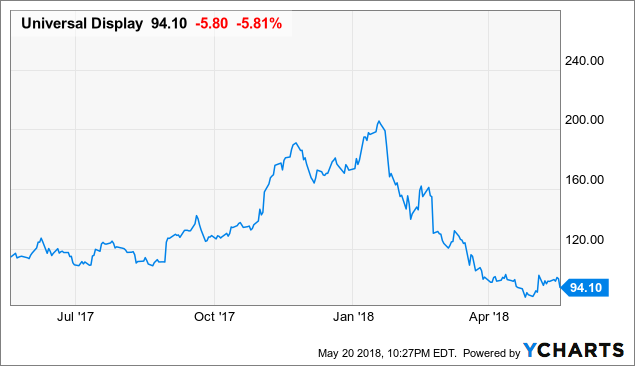
Since peaking at over $200 a share in February, Universal Display��s (OLED) gave the stock a lift back to over $100 share but even that rally faded. If EPS (earnings per share) growth will top 85 percent next year, implying a 27.7 times forward P/E, and 32.6 percent annually over the next five years, will OLED stock trade back at the 50 times forward earnings multiples, or $200 a share, anytime soon?

Universal Display

Management revised its 2018 revenue guidance to between $280 million and $310 million. In terms of materials sales, it believes the first quarter is a ��bottom�� for the year. At first, OLED stock slumped after the downside guidance, since expectations for ��significant�� growth in OLED panel demand failed to assure investors. In the near-term, the company still expects weak OLED panel demand due to the soft smartphone environment. This echoes the outlook of that of Samsung and LG.

Chart OLED data by YCharts

Headwinds Worsen on Vague Outlook

Universal��s forecast of OLED growth, not in financial terms but in measures, is puzzling. The company could be avoiding the real headwinds from Apple Inc.(AAPL) using LED displays to lower costs. This poses a business challenge for Universal Display because a shift away from OLED would end the rich royalties the company currently enjoys. The company said:

Looking out for 2019, we anticipate the significant growth in the OLED industry to resume, as we expect the installed capacity base as measured in square meters to increase by approximately 50% by the end of 2019, as compared to the end of 2017.

Source: SA Transcript

The company must now pin its revenue growth in 2019 to LG Display��s (LPL) OLED TVs. Investors of Himax Technologies (HIMX) will already know that OLED and 8K televisions could drive television sales in the future. In its conference call, Himax said:

TV makers are rushing to develop super high-end products with 8K resolution. I am pleased to report that our team has recently secured another 8K TV design win for a major panel maker and expect more to come in the next few quarters. We expect a low-single-digit sequential revenue growth for large display driver ICs, a double-digit growth year-over-year.

Source: SA Transcript

Chart HIMX data by YCharts

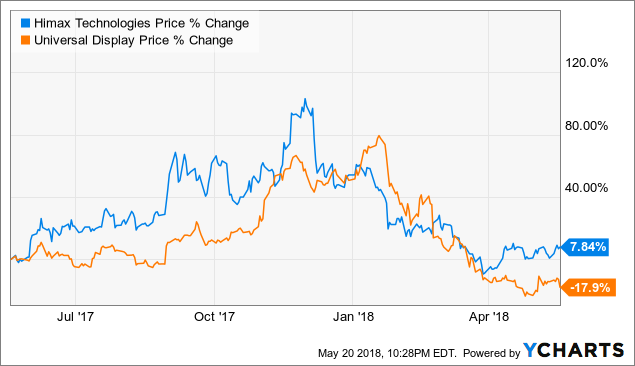
Even though both stocks priced in the potential in sales stemming from OLED or 8K televisions, Himax is a more diversified company with a market capitalization of just $1.24 billion. OLED stock is valued at fourfold times more, leaving it little room to disappoint investors.

Despite the unknowns Universal Display faces, the smartphone refresh from Sharp, using Gen4 panels and BOE technology ramping up the use of Gen6 flexible OLED will give the company some booked sales for next year. BOE invested $7.3 billion in the plant and is committed in delivering devices having OLED displays.

China is another region whose fragmented Android market will not deter suppliers in building devices having OLED display.

Growth in Automotive

The rise in autonomous automobiles and infotainment created more demand per vehicle for technology components. Ambarella (AMBA) will benefit from CV1 (computer vision) sales to car suppliers. Intel (INTC) already expects billions in sales thanks to Mobileye. Nvidia (NVDA) DRIVE testing continues in artificial environments. For Universal Display, the company has an addressable market of just $4 million in automotive OLED display today. By 2022, the TAM (total addressable market) is $5 billion.

Near-term Risks

Investors are demanding more than the promise of potential revenue next year or by 2022. Near-term risks are higher than average. In the first quarter, premium smartphone demand weakened, causing OLED panel demand to fall. Total material sales fell to $25.3 million, compared to $46.6 million last year. Green/Yellow emitter sales totaled $17 million, compared to $33 million last year. EPS of $0.13 is down from $0.22 last year.

Cheap LED Displays

OLED stock is pricing in the potential competition from smartphone makers like Apple using cheaper LED displays. But if OLED is more efficient with power, is more cost-efficient and offers better performance, smartphone makers cannot afford to leave OLED out. Conversely, if premium phone demands continue to weaken, smartphone designers must cut component prices drastically to drive demand. Universal Display would need to dramatically cut prices by lowering its royalty rates.

Valuation and Takeaway

Universal Display is very unlikely to re-visit $200 any time soon. Investors irrationally mispriced the stock in their belief that demand for premium, expensive smartphones would continue indefinitely. Though LED displays may replace OLED, the OLED technology is still a better choice. Prices must fall for OLED, so the price-earnings multiples on Universal Display stock may need to come down, too.

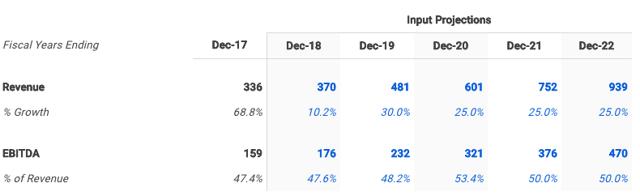
Of all the fair value models on OLED stock, which implies a price target of $89, a 5-year DCF Growth Exit model would suggest the stock already trades at a fair value at $97. This assumes that revenue grows in the range of 10 percent to 30 percent over the nex t five years.

Source: finbox.io (click on the link to change assumptions)

Please [+]Follow me for value stocks on sale. Click on the big "follow" button beside my avatar.

Disclosure: I am/we are long HIMX.

I wrote this article myself, and it expresses my own opinions. I am not receiving compensation for it (other than from Seeking Alpha). I have no business relationship with any company whose stock is mentioned in this article.

Sunday, May 20, 2018

Century Casinos (CNTY) Upgraded to “Buy” by ValuEngine

ValuEngine upgraded shares of Century Casinos (NASDAQ:CNTY) from a hold rating to a buy rating in a report issued on Thursday.

Several other research firms have also recently issued reports on CNTY. Zacks Investment Research raised shares of Century Casinos from a sell rating to a hold rating in a research note on Tuesday, January 30th. TheStreet cut shares of Century Casinos from a b rating to a c+ rating in a research note on Friday, April 6th. Finally, BidaskClub cut shares of Century Casinos from a hold rating to a sell rating in a research report on Tuesday, February 6th. Two analysts have rated the stock with a sell rating, one has assigned a hold rating and three have given a buy rating to the company. The company currently has a consensus rating of Hold and a consensus target price of $11.00.

Get Century Casinos alerts:

Shares of Century Casinos traded up $0.04, hitting $8.66, during mid-day trading on Thursday, Marketbeat.com reports. 641 shares of the stock were exchanged, compared to its average volume of 113,395. Century Casinos has a twelve month low of $8.45 and a twelve month high of $8.45. The stock has a market capitalization of $246.06 million, a P/E ratio of 19.24, a P/E/G ratio of 0.92 and a beta of 0.02. The company has a debt-to-equity ratio of 0.26, a current ratio of 2.25 and a quick ratio of 2.22.

Century Casinos (NASDAQ:CNTY) last released its quarterly earnings results on Wednesday, May 9th. The company reported $0.03 earnings per share (EPS) for the quarter, missing the Thomson Reuters’ consensus estimate of $0.05 by ($0.02). Century Casinos had a return on equity of 6.15% and a net margin of 3.17%. The firm had revenue of $40.62 million for the quarter, compared to analyst estimates of $38.15 million. analysts forecast that Century Casinos will post 0.37 EPS for the current year.

In related news, CEO Erwin Et Al Haitzmann sold 41,872 shares of the firm’s stock in a transaction that occurred on Friday, May 11th. The shares were sold at an average price of $8.43, for a total value of $352,980.96. The transaction was disclosed in a legal filing with the SEC, which is available through this link. 14.50% of the stock is currently owned by company insiders.

Hedge funds and other institutional investors have recently bought and sold shares of the stock. Citadel Advisors LLC purchased a new position in Century Casinos in the fourth quarter valued at approximately $100,000. Engineers Gate Manager LP purchased a new position in Century Casinos in the first quarter valued at approximately $106,000. Connors Investor Services Inc. purchased a new position in Century Casinos in the first quarter valued at approximately $149,000. Strs Ohio purchased a new position in Century Casinos in the fourth quarter valued at approximately $151,000. Finally, Stifel Financial Corp raised its holdings in Century Casinos by 88.7% in the first quarter. Stifel Financial Corp now owns 24,876 shares of the company’s stock valued at $187,000 after buying an additional 11,690 shares during the period. Hedge funds and other institutional investors own 77.99% of the company’s stock.

Century Casinos Company Profile

Century Casinos, Inc operates as a casino entertainment company worldwide. The company develops and operates gaming establishments, as well as related lodging, restaurant, horse racing, and entertainment facilities. It owns and operates casinos in North America and Poland; a racetrack and entertainment center in Canada; and pari-mutuel off-track betting network in southern Alberta, Canada.

To view ValuEngine’s full report, visit ValuEngine’s official website.